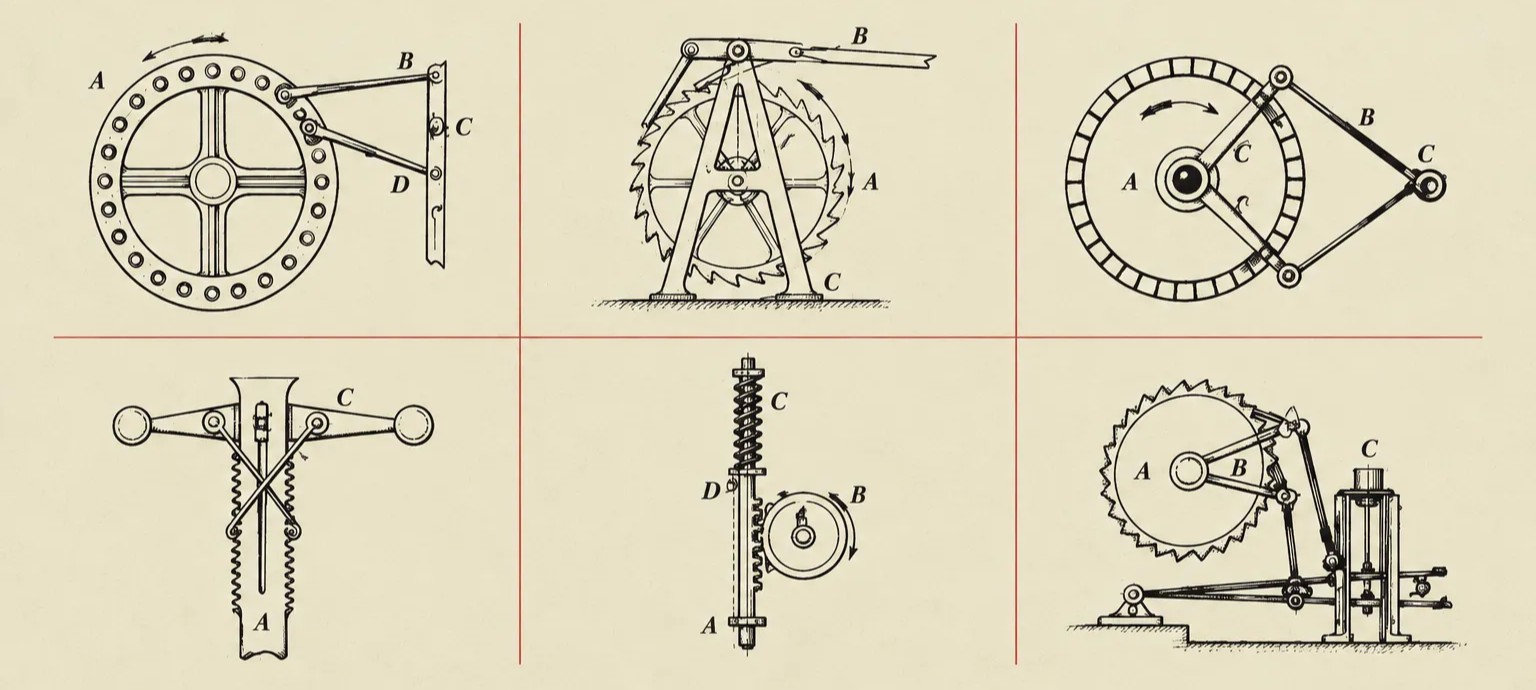
In 1920, around 135,000 people crowded into the Grand Central Palace in New York over a single week to push buttons and watch machines move. The exhibit was called Mechanical Wonderland. Panel after panel of working models showed gears meshing, ratchets clicking and cams lifting hammers, and each panel started up at the touch of a button. Its maker was William M. Clark, a hobbyist from South Orange, New Jersey, who had spent twenty years or more building it.
Clark had not learned mechanics through regular schooling. By his own account, the foundation of his education was a single book that he treated as a textbook.
That book was Five Hundred and Seven Mechanical Movements, first published in New York in 1868.
Its compiler, Henry T. Brown, was a patent attorney, which suits a book full of other people's inventions. His firm published a weekly journal for inventors called the American Artisan, and from 1864 he ran drawings of mechanical movements in its pages. Readers liked them enough that he gathered the collection into a single volume. In the preface he admits the order is untidy, since the work was done in whatever time his professional duties left over. He leaned on two things instead: a very thorough index, and a layout he called entirely novel, with a drawing on the left-hand page and its description on the page facing.
The book starts with the lever and the other basic mechanical powers, then moves outward through gears, cams, cranks, clutches, brakes and drills. Further in come the machines of its own day: a governor for a steam engine, a watch escapement, a safety stop for elevators, the grasshopper beam engine. The aeolipile, a steam-driven spinning ball usually credited to Hero of Alexandria, has an entry of its own.
Each entry is short, rarely more than a paragraph, and read in sequence they begin to repeat themselves in a useful way. The same few problems return in different forms. Rotation has to become straight-line motion. Motion has to stop and start on schedule. A small input has to become a large force, or a long reach. The answers come from an era of steam, waterwheels and hand cranks, and many of them work on geometry alone.
Three examples show the range.
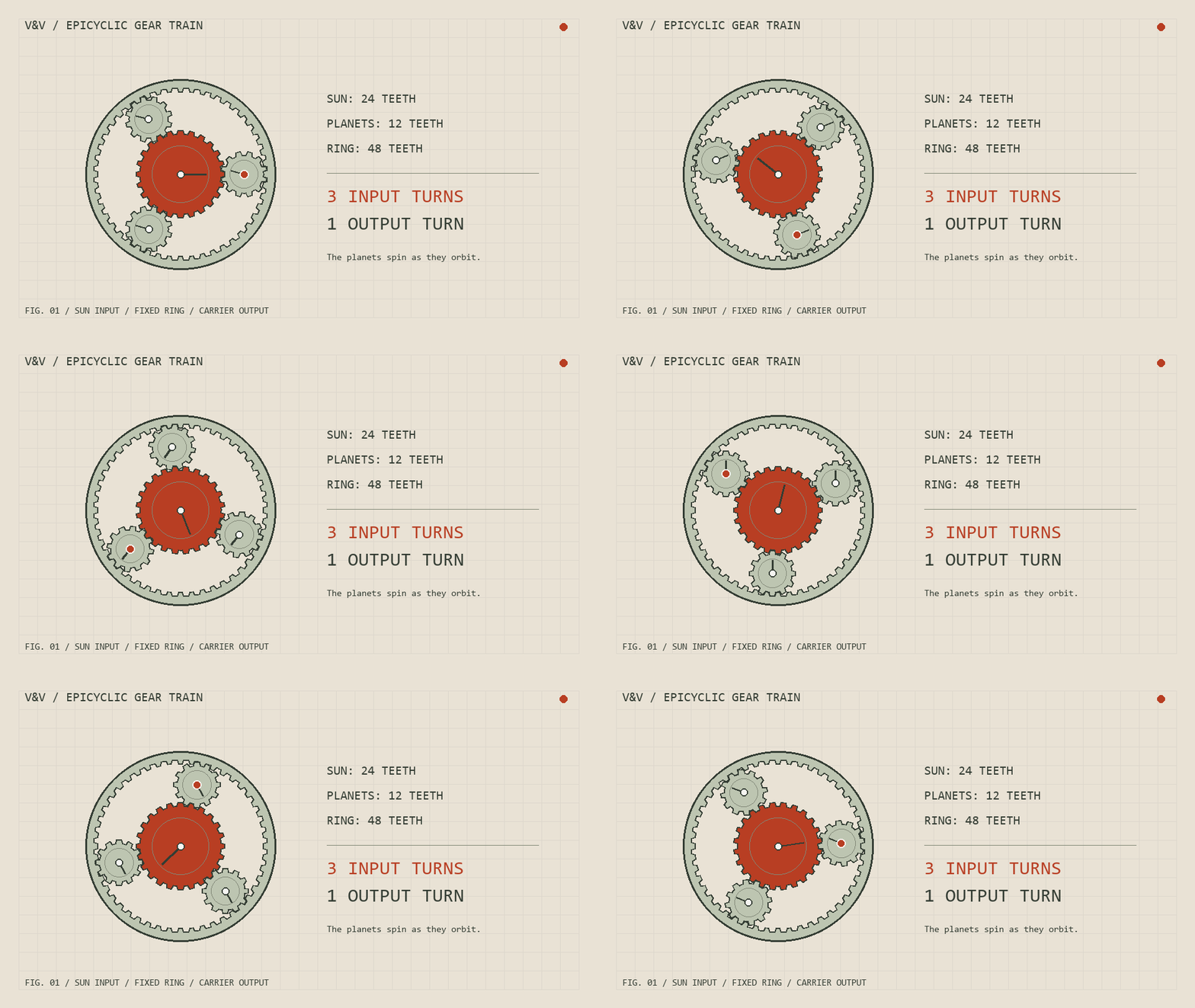
The epicyclic gear train
Gears that orbit a central gear while also spinning on their own axes. This packs a large speed reduction into a compact, in-line package, which is why planetary gearboxes sit inside so many motors and actuators today.
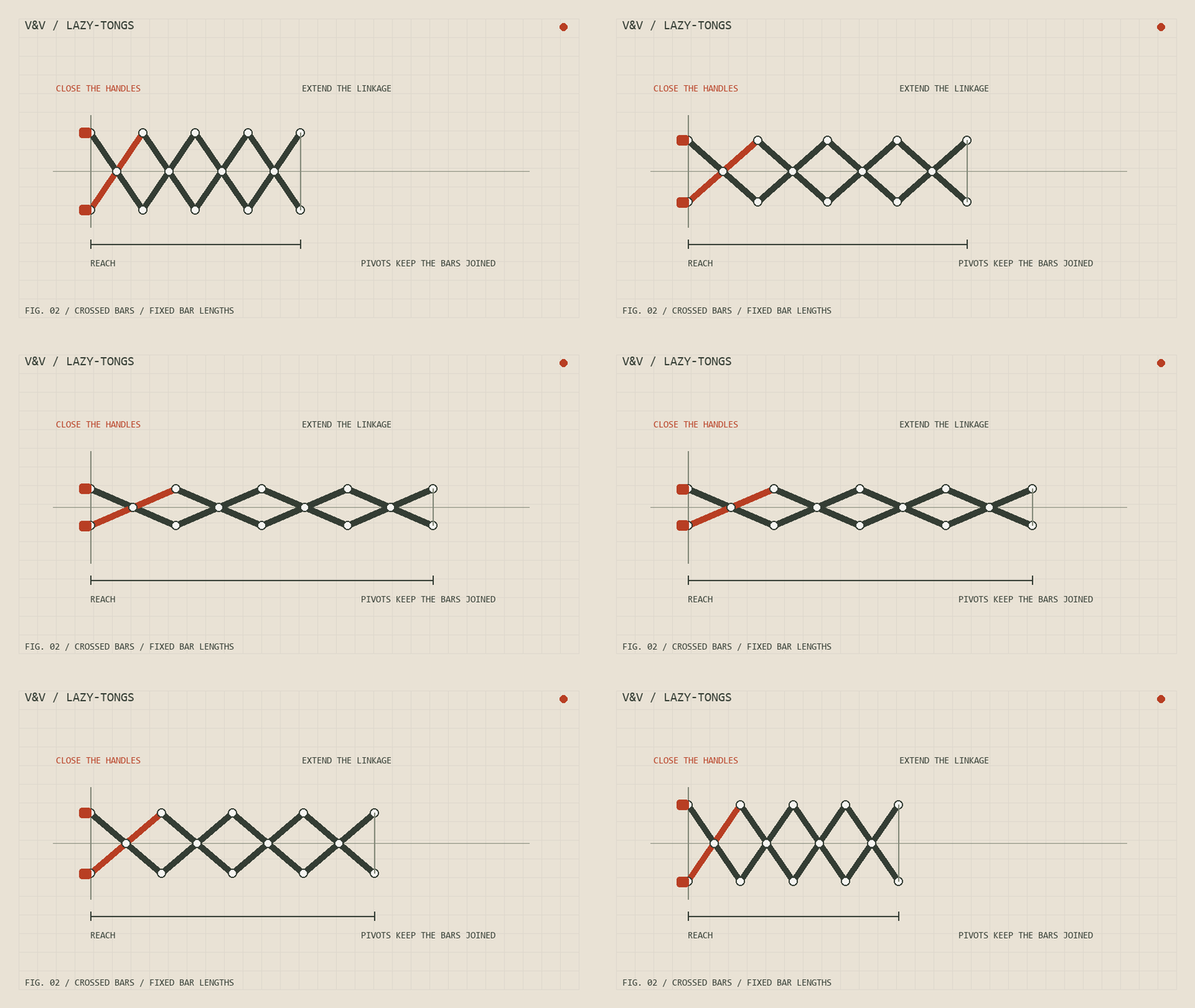
Lazy-tongs
A chain of crossed bars on pivots that stretches a long way when the handles move a little. The same geometry runs scissor lifts and pantographs, anywhere a short stroke has to become a long reach.
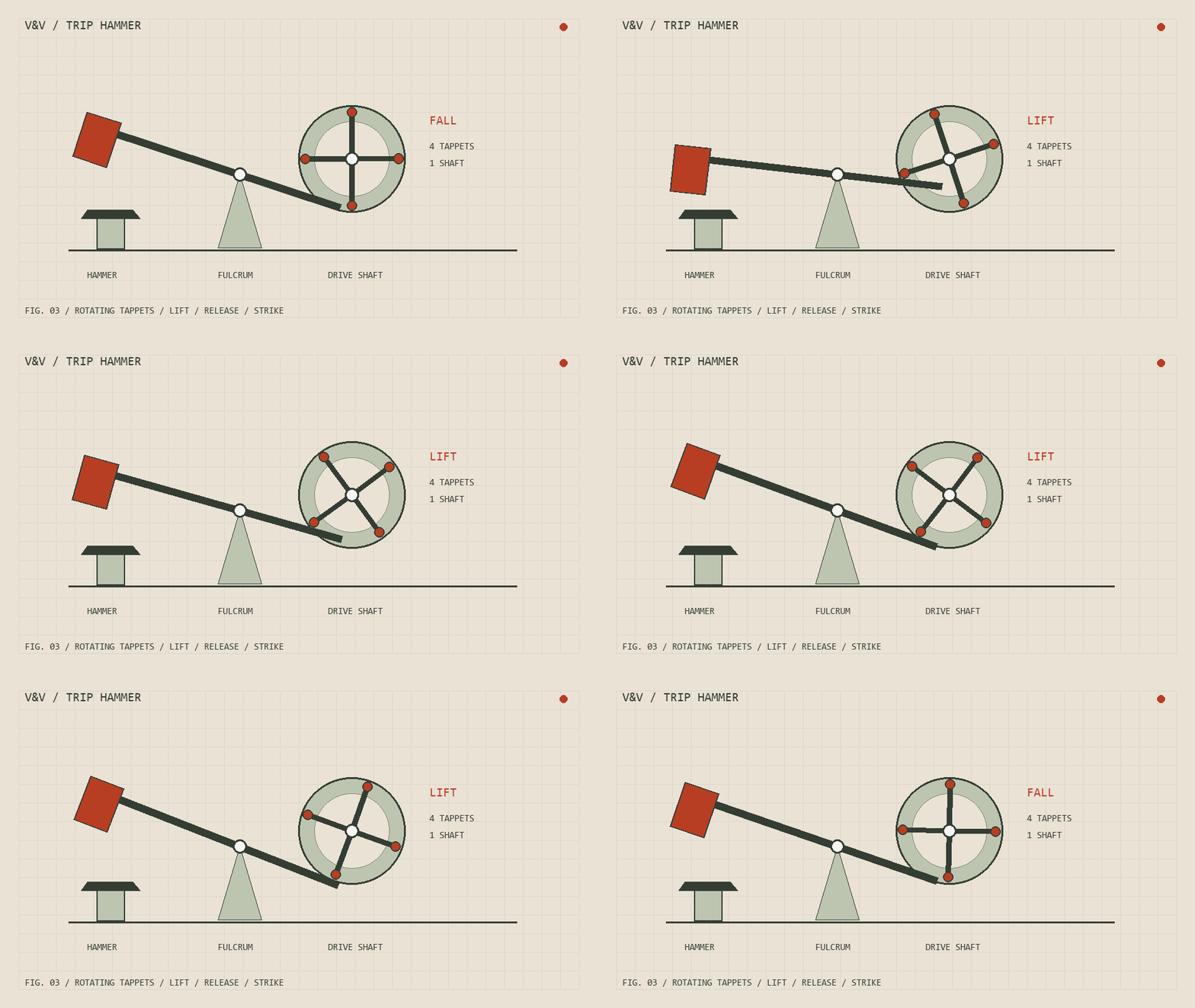
The trip hammer
A rotating shaft lifts a heavy hammer with cams and lets it fall, over and over. Steady rotation goes in and repeated impact comes out, the same conversion that cams perform in engines and factory machinery.
Those three are a small slice of the book. The rest of it is free to read. The Internet Archive hosts scans, and Dover and others sell reprints for anyone who prefers paper. Matt Keveney's site, 507movements.com, carries the text and drawings of the 21st edition, published in 1908, and has animated a good share of them. The colored thumbnails mark the ones that move. That the book reached a 21st edition at all says something about how long it stayed useful.
Clark's panels survived too. One set ended up at the Museum of Science in Boston.
For real machinery in motion, Ralph Steiner's 1930 short film Mechanical Principles shows mechanisms of this kind in operation.
A good way through the book is one entry at a time: study the drawing, guess what it does, then read the description. If you find a movement you want explained properly, send it in. A few of them will probably end up in future issues.
Have a correction or a different result? Write to the editor.